
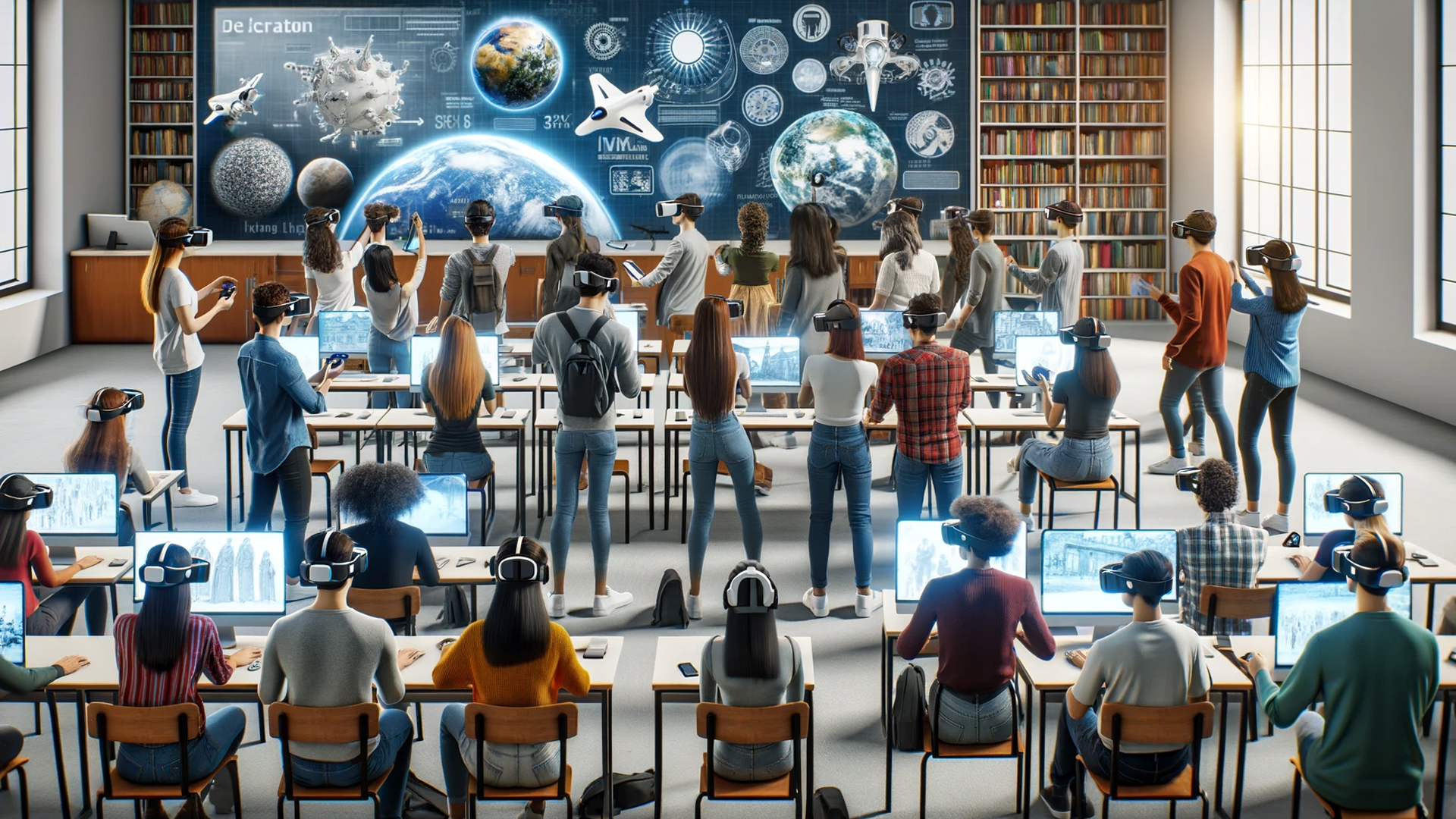
Virtual reality (VR) is rapidly transforming the landscape of university education, presenting a revolutionary approach that intersects cutting-edge technology with dynamic learning experiences. As an increasingly important tool in the arsenal of modern educational methods, VR stands out for its ability to provide immersive, interactive, and innovative learning opportunities. This technological marvel is not just a futuristic concept but a practical tool that is reshaping how knowledge is acquired and experienced in academic settings.
In the realm of higher education, where the need for advanced learning techniques and engagement is paramount, VR offers a unique blend of features that cater to diverse learning styles and subject matters. Its versatility and adaptability make it an ideal platform for students across various disciplines to delve deeper into their fields of study. Whether it’s exploring the intricacies of molecular biology, walking through historical events, or simulating complex engineering problems, VR brings an unparalleled depth to the educational experience.
The implications of incorporating VR into university curricula are profound. It heralds a new era of educational methodologies, marked by enhanced engagement, improved comprehension, and a deeper connection to the subject matter. Students are no longer passive recipients of information; instead, they become active participants in a vivid, sensory-rich learning journey.
From providing immersive learning experiences that captivate and inspire, to offering safe and cost-effective simulations of real-world scenarios, the advantages of VR in higher education are manifold and significant. Let’s explore these benefits in detail, highlighting how VR is not just transforming the way we learn but also preparing students for a future in which technology plays an increasingly central role.
- Immersive Learning Experiences: The use of VR in education transforms traditional learning methods by creating a fully immersive environment. This immersion allows students to engage with content in a way that is significantly more interactive than traditional textbooks or lectures. For instance, in a VR setting, a student studying architecture can virtually walk through buildings, understanding spatial relationships and design elements in a way that flat diagrams can’t convey. Similarly, art students can explore virtual galleries, experiencing artworks as if they were physically present. This level of immersion can lead to a deeper understanding of the material, as students are not just passive recipients of information but active participants in a learning experience that engages multiple senses.
- Enhanced Understanding and Retention: VR’s immersive nature fosters an experiential form of learning which is often more memorable than traditional methods. For example, in medical education, students using VR can perform virtual surgeries, allowing them to learn and make mistakes in a risk-free environment. This hands-on approach not only enhances understanding but also significantly improves retention. The sensory engagement in a VR environment means that students are likely to remember their experiences more vividly. It’s one thing to read about a historical event, but quite another to virtually experience it, which can create lasting educational impressions.
- Safe Simulation of Real-World Scenarios: In fields like medicine, engineering, or chemistry, practical experience is invaluable. VR enables students to simulate experiments, surgeries, or construction projects without the risks associated with real-life trials. For example, medical students can practice complicated surgical procedures in a virtual environment multiple times, gaining confidence and competence without any risk to patients. Engineering students can test the integrity of structures under various simulated conditions, allowing for a deeper understanding of materials and physics without the need for costly physical prototypes.
- Accessibility to Remote or Historical Locations: VR can virtually transport students to places they might never be able to visit physically. History students can explore ancient civilizations, walk through historical events, or visit archaeological sites that are otherwise inaccessible. Geology students can explore the depths of the Earth or the surface of Mars. This level of access can significantly enrich the educational experience, making learning more exciting and dynamic.
- Collaboration and Social Learning: The collaborative potential of VR is significant, especially in a world increasingly moving towards remote and digital interaction. Students can work together in virtual environments from different geographical locations, fostering teamwork and communication skills that are essential in the modern workplace. For instance, students in a virtual lab can collaborate on experiments, sharing observations and findings in real-time, despite being in different parts of the world.
- Customization and Personalization: The adaptability of VR to different learning styles is a significant advantage. Interactive VR applications can be designed to adapt to the user’s responses, providing a more personalized learning journey. For visual learners, complex visual information can be presented in an engaging and understandable way. Kinesthetic learners can benefit from the ability to interact with the virtual environment, enhancing their understanding through action and manipulation.
- Breaking Down Complex Concepts: In fields where concepts are particularly abstract or complex, VR can provide a means of breaking them down into more digestible parts. For example, in molecular biology, students can explore 3D models of complex molecules, manipulating them to understand their structures and functions. In physics, VR can be used to visualize and interact with theoretical concepts like quantum mechanics or relativity, making these difficult subjects more accessible.
- Increased Motivation and Engagement: The novelty of VR can significantly boost student motivation and engagement. This technology can turn learning into an exciting and enjoyable experience, which is particularly useful for subjects that students might find challenging or uninteresting. The immersive nature of VR makes learning more like a game, which can be particularly appealing to the digital-native generation.
- Preparation for Future Technologies: As VR and other emerging technologies become more prevalent in various industries, exposure to these tools at the university level is crucial for preparing students for future careers. By learning to use VR, students gain skills that are increasingly in demand across a wide range of professions. This not only makes them more attractive to future employers but also equips them with the ability to adapt to and utilize future technological advancements in their respective fields.
The integration of VR in university education offers a multifaceted array of benefits. It creates engaging, immersive, and interactive learning experiences that can enhance understanding and retention, provides safe environments for practical learning, enables access to otherwise inaccessible locations or scenarios, fosters collaboration, offers customizable and personalized learning experiences, simplifies complex concepts, increases student motivation and engagement, and prepares students for a future in which technology plays a pivotal role.